About The Song
Late on the night of August 27, 1957, nineteen year old University Of Georgia student Bill Anderson sought refuge from the heat and humidity which had invaded his small room in the Andrew Jackson Hotel in Commerce, Georgia. Climbing up a flight of stairs that led to the building’s roof, the young man plopped down in an old well-worn chair and took in the view. Tired from a long day of classes and a tedious evening shift as a disc jockey at local station WJJC, his body and mind craved sleep. Yet, on this particularly clear night, as Anderson noted the beauty of the millions of stars that blanketed the heavens, sleep was the last thing on his mind. After hours of spinning the latest country hits on the radio, there was music in his head and it had energized him. He had taken his guitar up to the roof with him that night, and as he looked across the city’s meager skyline, he began to play. As Bill strummed the guitar, studying the few lights that were blinking at this late hour, a thought came to him. As he glanced again to the sky and then back to the city streets, inspiration struck like lightning. Pulling an envelope from his pocket, he began to jot down his thoughts with a pencil. These random thoughts would radically change his life’s course.
“You know, there weren’t a half a dozen lights in Commerce, Georgia at that time,” Anderson once said, “and yet those lights grew in my mind to a ‘great white way.’ Then in the second verse, I looked to the sky and thought ‘did the God who put those stars above, make those city lights?’ Within a few minutes, I had completed the song. My dad later told me that he knew I had a writer’s imagination if I could look out over Commerce, Georgia and write about a ‘great white way’.” On that night, Anderson was not only a visionary; he was a bit of a philosopher too. He saw beyond the small town where he lived, and walked through places he had never visited. In contrasting the draw of a sinful world of bars and honky-tonks to the purity of a heaven awash with bright lights, he summed up the everyday battle for man’s soul. His latest composition was a moral ode that raised questions about the evil and temptations a country boy faces when he leaves his home for the city streets. He was painting every mother’s worst nightmare.
Sensing he had something special, Bill made a recording of “City Lights” in a nearby television studio and shipped it to Bob Tanner at TNT Music in San Antonio, Texas. Anderson had found TNT by writing to almost every publisher in the country hoping to land a home for his compositions. Bob Tanner was the only one who’d responded. TNT had released Anderson’s first two efforts on their own label. Still, because Tanner had not made any money on Bill’s first attempts, he was ready to simply pass on “City Lights.” Then Anderson saved the deal by saying the magic words: “I’ll pay if you press a few records off my own recording.” The promise of money was the key as Tanner went to work, putting one of Bill’s other demos “(I’ve Got) No Song To Sing” on the flip side.
As a disc jockey, Bill rarely played “City Lights” on his show. At the local dances he noticed the kids going crazy for “No Song To Sing,” so he figured his best shot was with the rocker, not the ballad. Fortunately, Charlie Lamb, a music reporter, happened to listen to “City Lights” when he reviewed the copy Anderson had sent his way. Lamb thought it was a powerful piece of work and took it to RCA Victor’s A & R director Chet Atkins. Chet reviewed it, liked what he heard, and forwarded “City Lights” on to Dave Rich, without a doubt the most obscure artist ever signed by RCA. The label merely used him as a tax write-off. Rich cut the song and RCA did release it, but his record failed to make the charts. Still, Anderson was thrilled just getting a Nashville recording on one of his songs, a dream come true for the college student. In the end, Dave Rich not only never had a hit, but his name never appeared on any chart.
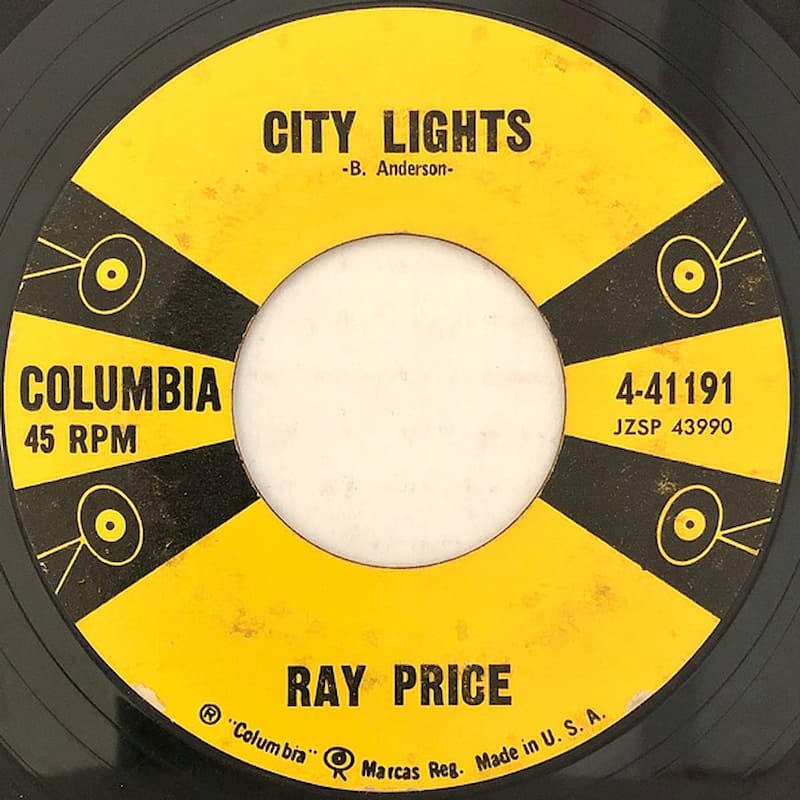
Bill’s composition would probably have been forgotten right then and there if Ernest Tubb and Ray Price hadn’t made an appointment to play golf. Riding in a car equipped with a radio, the two country music stars caught the Dave Rich recording of “City Lights” on one of the few times it ever made the airwaves. Tubb commented that it sure did sound like Price’s kind of song. Ray dismissed the veteran’s remarks, but Ernest wouldn’t stop hounding him. “’City Lights’ is just your style,” Tubb prodded. “You could have a huge hit with that. If I were you, I would cancel whatever I was about to release and cut it.” One week later, Price accepted Tubb’s advice and took “City Lights” into the studio. Ray’s record was released in July of 1958 and locked onto the #1 position by October 20th, where it would remain for thirteen weeks. In the midst of the youth and rock explosion, a quiet song with profound lyrics had not only become the year’s biggest country hit, but had opened Nashville to a small-town college boy from Georgia, and he would make the most of it.
In the years that followed, Bill Anderson came to be regarded as one of Nashville’s all-time greatest songwriters. In fact, Billboard Magazine ranks Anderson as the 3rd most prolific country songwriter, behind only Harlan Howard and Bob McDill. Over four hundred of Bill’s compositions have been recorded, and many of them passed the point of being hits and have become classics. As a performer, Anderson’s own recordings landed on the national playlists more than eighty times, and five of his records reached #1 on Billboard’s country singles chart. He has won countless awards for his songwriting and performing, and was inducted into the Country Music Hall Of Fame in 2001. Yet, possibly the most meaningful, professional tribute to Bill came in the late 1970s when the city of Commerce, Georgia erected a marble monument in front of the building which formerly housed the old Andrew Jackson Hotel. The writing etched in granite reads: “Bill Anderson, Country Music Hall Of Fame Songwriter, wrote his first hit “City Lights” here, on August 27, 1957.” I personally regard “City Lights” as, lyrically, the greatest country song ever written. An absolute poetic masterpiece and the fact that it was composed by a nineteen year old kid makes the achievement all the more incredible
Video
Lyric
A bright array of city lights as far as I can see
The great white way shines through the night for lonely guys like me
The cabarets and honky tonks their flashing signs invite
A broken heart to lose itself in the glow of city lights
Lights that say forget her name in a glass of cherry wine
Lights that offer other girls for empty hearts like mine
They paint a pretty picture of a world that’s gay and bright
But it’s just a mask for loneliness behind those city lightsThe world was dark and God made stars to brighten up the night
The God who put the stars above I don’t believe made those lights
Oh it’s just a place for men to cry when things don’t turn out right
Just a place to run away and hide behind those city lights
Lights that say forget her love in a different atmosphere
Lights that lure are nothing but a masquerade for tears
They paint a pretty picture but my arms can’t hold them tight
And I just can’t say I love you to a street of city lights